photo 3ec5abe8-497d-41af-a7dd-29050aea8f7e.jpg

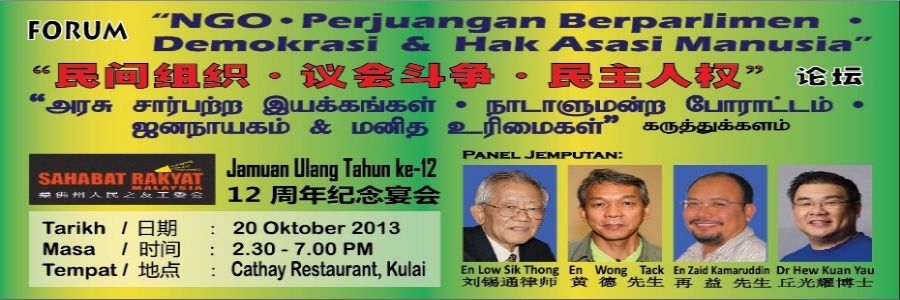
“民间组织・议会斗争・民主人权”论坛 ——人民之友工委会12周年纪念

Showing posts with label English. Show all posts

Sunday, December 8, 2013

MAS Must Immediately Revoke Suspension of Union President Ismail Nasaruddin; Worker Right Issue Should Be Resolved By Negotiations Not ‘Union Busting’

MAS Must Immediately Revoke Suspension of 
Union President Ismail Nasaruddin;
Worker Right Issue Should Be Resolved By Negotiations 
Not ‘Union Busting’

3 December 2013


We, the 43 undersigned civil society groups, trade unions and organizations are disturbed by the news that Malaysian Airlines, a government linked company, has suspended the president of the National Union of Flight Attendants Malaysia (NUFAM), Ismail Nasaruddin in connection with a statements made to the media by the Union, which amongst others suggested that MAS’s Chief Executive Officer (CEO), Ahmad Jauhari Yahya who was appointed in 2011, should resign. Ismail was allegedly suspended without allowances with immediate effect starting Nov 8 following a news report quoting him that was published on the same day.

According to a news report, ‘…NUFAM Secretariat said it is calling on the prime minister to review Jauhari's contract and remove him as the CEO of MAS, which is a government appointed position, unhappy that there has been no changes in resolving the cabin crew's problems…’ (The Sun Daily, 8/11/2013, NUFAM calls for resignation of MAS' CEO).

Amongst the alleged grievances being raised by NUFAM, which represents 3,500 cabin crew at Malaysia Airlines (MAS), as was contained in the said Sun Daily report are:-

· New policy imposed by MAS on a weight control ruling where cabin crew are told to reduce their weight to achieve a certain body mass index within three to six months. Failure to do so would result in an automatic transfer to ground work. The new rule is also a blanket policy and affects all cabin crew members including those who have just returned from maternity leave and may find it difficult to drastically lose weight within a short time frame;

· Cabin crew who joined in 2004 or later are no longer able to enjoy the transport services provided by the airline for pick-up from home, and Ismail said this is unfair to those who joined in 2004 or later, as they had signed contracts that included transportation as part of the benefits; and

· That the MAS management have allegedly cut costs drastically which affected the cabin crew resulting also a failure to review allowances and salaries.

We are especially concerned with this ‘weight control ruling’ which certainly is discriminatory against women, especially to those returning from pregnancy. Increase of body mass index sometimes may be beyond the control of a human being, and this really should not be used to affect their employment.

NUFAM alleges that it wants MAS to sit down with the Union to discuss and negotiate a new Collective Bargaining Agreement (CBA/CA) but apparently MAS is not interested to do so at this moment, citing as reason some judicial review.

Now, MAS has commenced disciplinary actions against Ismail Nasaruddin, and according to a Malaysiakini report, it is allegedly because MAS said Ismail had acted in contradiction with his duties as a chief steward of the airline by issuing the statement. (Malaysiakini, 14/11/2011, MAS suspends chief steward for criticising CEO)

Now, clearly the statements were made by Ismail in his capacity as President of the Union, representing some 3,500 workers, and as such he has the duty and obligation to fight for the rights of workers and that includes applying pressure on the employer and even calling for the removal of any of such employer’s officers or even Directors who is standing in the way of a prompt resolution of the dispute. Unlike employers, every day that a worker’s issues is not resolved, it is the workers that will continue to suffer. A prompt resolution is best and just.

No worker, group of workers or unions should be barred from making public statements to the media or otherwise in the struggle for worker rights and human rights. This right is clearly acknowledged in the Declaration on the Right and Responsibility of Individuals, Groups and Organs of Society to Promote and Protect Universally Recognized Human Rights and Fundamental Freedoms, commonly known today as the UN Human Rights Defender Declaration.

We condemn the action of Malaysian Airlines (MAS) in commencing disciplinary actions against a Union leader, and urge MAS to immediately stop this and revoke the suspension of Ismail Nasaruddin.

We call on MAS to immediately sit down, negotiate and resolve these outstanding worker issues with the trade union rather than resorting to ‘union busting’ strategies which include disciplinary actions against worker and union leaders who dare to fight for worker rights.

We call on the Malaysian government to immediately to act, given the fact of the much influence it has in a government-linked company like MAS, to ensure that justice is done for Ismail Nasaruddin, the Union and its members.

Senator Syed Shahir bin Syed Mohamud - Senator in the Malaysian Parliament
Charles Hector - Human Rights Defender and lawyer;
Mohd Roszeli bin Majid - Vice President (Private Sector) Malaysian Trade Union Congress(MTUC), and also the President of the TNB Junior Officers Union;
Pranom Somwong - Workers Hub For Change (WH4C), Asia Pacific Forum on Women , Law and Development ( APWLD);

For and on behalf of the following 43 civil society groups, trade unions and organizations

ALIRAN
Asia Pacific Forum on Women, Law and Development (APWLD)
Cambodian Human Rights and Development Association (ADHOC)
Center for Orang Asli Concerns (COAC)
CWI Malaysia (Committee For A Workers International Malaysia)
Damn the Dams
Dignity International-Asia
Friends of Burma
Human Rights Ambassador for Salem-News.com, United Kingdom
Jaringan Rakyat Tertindas(JERIT)
Kesatuan Eksekutif AIROD (KEA)
Kesatuan Pekerja-Pekerja Polyplastics Asia Pacific
Kesatuan Sekerja Industri Elektronik Wilayah Selatan Semenanjung Malaysia (KSIEWSSM)
MADPET (Malaysians Against Death Penalty and Torture)
Malaysians for Beng Hock
Malaysia Youth & Students Democratic Movement (DEMA)
MTUC Pahang
National Union of Hotel, Bar and Restaurant Workers (NUHBRW)
Network of Action For Migrants in Malaysia (NAMM)
Paper and Paper Products Manufacturing Employees Union (PPPMEU)
Philippine Alliance of Human Rights Advocates (PAHRA)
Parti Rakyat Malaysia (PRM)
Parti Sosialis Malaysia (PSM)
Partido ng Manggagawa (Labor Party-Philippines)
Pax Romana-ICMICA Asia
Peoples' Green Coalition
Persatuan Kesedaran Komuniti Selangor (EMPOWER)
Persatuan Sahabat Wanita, Selangor
Pusat KOMAS
Sahabat Rakyat Working Committee
Sarawak Dayak Iban Association[SADIA]
SUARAM
Tenaga Nasional Junior Officers Union (TNBJOU)
Tenaganita
The Filipino Women's Organization in Quebec
WIRDA (Women’s Institute Research Development and Advancement), Malaysia
Women’s Centre for Change Penang
Workers Hub For Change (WH4C)
Yayasan LINTAS NUSA – Batam, Indonesia
Saya Anak Bangsa Malaysia (SABM)
Law and Society Trust.Colombo Sri Lanka
ITUC(International Trade Union Confederation)

Friday, November 8, 2013

砂州建设水坝损害原住民“习俗地权利” 民间组织群起支持维权反“坝”抗争行动 / Malaysian Civil Society Supports the Protection of Orang Asal's Native Customary Rights against the Construction of Dams in Murum and Baram, Sarawak

  砂州建设水坝损害原住民“习俗地权利”
民间组织群起支持维权反“坝”抗争行动

Malaysian Civil Society Supports the Protection of Orang Asal's Native Customary Rights against the Construction of Dams in Murum and Baram, Sarawak

2013年11月6日


对于砂拉越州巴贡(Bakun)、姆伦(Murum)及巴南(Baram)水力发电水坝的建设违反了砂拉越原住民社群的原住民习俗权利一事,马来西亚公民团体感到愤怒。

为此,“反对水坝联盟”发表一篇声明,获得马来西亚各团体组织(包括本会)及个人认同与签署。此声明中文版全文如下:

违反原住民权利

在首长泰益管理下的砂拉越州政府一直不断在侵犯砂拉越原住民的权利:
1.非法剥夺他们的原住民习俗地
2.非法砍伐森林
3.在峇当艾(Batang Ai)、巴贡(Bakun)和姆伦(Murum)建设的三个大型水坝而导致河水泛滥,还有另外九个将在巴南(Baram)和其他地区建设的水坝将导致同样结果
4.非法在原住民习俗地上单一培植油棕
5.在砂拉越沿海一带的工业区(SCORE)设立有毒、污染性高及消耗大量能源的冶炼等行业。
这种系统性及灾难性的环境破坏给以原住民社群带来了严重且无法挽救的伤害。原住民社群一至以来保护原始森林。原始森林不但供给了食物,还是他们小农场、长屋、生活小区、礼拜场所、教堂和墓地的所在地。他们的存在和文化是依赖着他们的土地和森林的。他们的土地就是他们的生命。

很显然的,将原住民从他们的土地驱逐出去是一种文化毁灭。为了让路以建设巴贡(Bakun)水坝而强行将原住民迫迁到双溪阿刹(Sungai Asap)已经导致该社群穷面临生计问题。该新居地区其实是油棕种植园的一部分,其土质并不适合用来种植山稻 米和其他农作物。它不仅离森林很远,也缺乏原住民所要求的学校和诊所。此外,其服务设施不但没有设立好,而且不卫生。这次强行迫迁像1948年至1960年马来亚紧急法令时期所设立的“新村”,生活环境如同难民营。

保护在姆伦(Murum)的原住民习俗地(设立路障)

由于砂拉越州政府与其关联企业没有合理回应本南族(Penan)所提出的公平赔偿,本南族从2013年9月23日就开始了第三次捍卫原住民习俗地权,从而设立路障。整个族群包括了妇女和儿童生活在帐篷下,至今饱受长达六周烈日和季候雨的折磨。


保护在巴南(Baram)的原住民习俗地(设立路障)

为了阻止巴南水坝进一步的预期建设工程,巴南的内陆族(Orang Ulu)也在2013年10月23日开始了类似的捍卫原住民习俗地权,从而设立路障。他们以和平的方式请巴南水坝工程的工人离开。水坝工人已经答应离开了工地,工程因而停滞不前。驱使工人离开水坝是以和平方式进行的。

马来西亚公民团体的诉求

一般马来西亚原住民的民权运动,特别包括在姆伦(Murum)和巴南(Baram)的原住民的民权运动,可说是马来西亚公民团体,在总体上反对人民受到压迫的运动中,不可分割的一部分。我们对这样的不公平待遇感到万分愤怒。正因如此,姆伦(Murum)和巴南(Baram)原住民的诉求也正是我们自己的诉求。

马来西亚公民团体对砂拉越州政府与其关联企业、承包商及代理提及的诉求如下:
1. 立即停止姆伦(Murum)水坝蓄水,并停止再焚烧对本南社群的长屋。恳请他们在不以恐吓、暴力、贪污、操纵以对本南社群(Penan)进行分化的情况下,与该社群进行公开且公正的咨询。

2. 立即停止与计划中的巴南(Baram)水坝的所有工程。恳请他们在不以恐吓、暴力、贪污、操纵以对巴南社群进行分化的情况下,与该社群进行公开且公正的咨询。

马来西亚公民团体对马来西亚皇家警察提及的诉求如下:
立刻停止警察路障,以允许食物和水的运送、不阻止医疗援助,社会工作者,记者和相关媒体工作者自由进出姆伦(Murum)。同时,也恳请马来西亚皇家警察能够呈现出其专业表现,保护姆伦(Murum)和巴南(Baram)原住民,行使他们的民权运动,从而根据马来西亚宪法所授予的权利与保证,在马来西亚过着和平的生活。

“反对水坝联盟”联系人:巴钦义
电话:012-4777706
电邮:pakhimghee@gmail.com

此文告获得以下马来西亚各团体组织(包括本会)及个人认同与签署:
1. Aliran
2. All Women's Action Society (AWAM)
3. ANGKATAN WARGA AMAN MALAYSIA (WargaAMAN)
4. Association of Women Lawyers
5. Ban Cyanide Action Committee, Raub, Pahang
6. Baramkini
7. Baram Protection Action Committee (BPAC)
8. Bersih Sibu, Sarawak
9. Borneo Resources Institute, Malaysia (BRIMAS)
10. Borneo Rights International, United Kingdom (BRI)
11. Biro Alam Sekitar Parti Keadilan Rakyat 
12. Center for Orang Asli Concerns 
13. Centre for Policy Initiatives (CPI)
14. Civil Rights Committee of Kuala Lumpur & Selangor Chinese Assembly Hall
15. Community Action Network (CAN)
16. Communities Information and Communication Centre (CICOM)
17. Dapur Jalanan Kuala Lumpur
18. ENGAGE
19. Friends in Conversation (FIC)
20. Gerakan Bunga Raya
21. Gindol Initiative for Civil Society, Borneo
22. Gabungan NGO Pengerang Johore
23. Helen Ting
24. Himpunan Hijau
25. Ho Yock Lin, President, AWAM
26. Jaringan Orang Asal SeMalaysia (JOAS) which comprises 89 CBOs.
27. Jaringan Rakyat Tertindas (JERIT)
28. Jaringan Tanah Hak Adat Bangsa Asal Sarawak (TAHABAS)
29. JOHOR YELLOW FLAME (JYF)
30. Kelab Bangsar Utama
31. Lee Hwok Aun Dr., Universiti Malaya
32. LLG Cultural Development Centre
33. Malaysia Youth and Student Democratic Movement
34. MADPET (Malaysians Against Death Penalty and Torture)
35. MALAYSIAN INDIANS PROGRESSIVE ASSOCIATION (MIPAS)
36. Malaysians for Beng Hock
37. Mama Bersih
38. New Era College Student Progressive Front
39. Northern Green Youth
40. Parti Sosialis Malaysia
41. People's Green Coalition
42. Persatuan Alumni PBTUSM Kuala Lumpur & Selangor (雪隆理华同学会)
43. Persatuan Kesedaran Komuniti Selangor (Empower)
44. Persatuan Komuniti Prihatin Selangor & Kuala Lumpur (PRIHATIN)
45. Persatuan Masyarakat Selangor dan Wilayah Persekutuan (PERMAS)
46. Persatuan Murid Murid Tua SJK (C) Pei Hwa
47. Persatuan Penduduk Taman Muhibbah
48. Persatuan Sahabat Wanita, Selangor (PSWS)
49. Pertubuhan Solidariti Hijau Kuantan ( PSHK)
50. Pusat Komunikasi Masyarakat (KOMAS)
51. Tan Sri Ramon Navaratnam
52. Saya Anak Bangsa Malaysia (SABM) 
53. Sahabat Rakyat Working Committee (人民之友工委会)
54. Save Vui Kong Campaign
55. Serdang Bharu School Alumni Youth Section
56. Solidariti Anak Muda Malaysia (SAMM)
57. SOS-Selangor
58. Save Malaysia Stop Lynas (SMSL)  
59. Suaram
60. Suaram Penang
61. Sunflower Election Education (SEED)
62. Tamil Foundation
63. Tan Siang Yong 陈湘荣, Chairman Kedah/Perlis Liaison Committee, LLG Cultural Development Centre
64. Tenaganita
65. Tindakmalaysia
66. Toh Kin Woon Dr.
67. Universiti Utara Malaysia Student Progressive Front
68. Universiti Sains Malaysia Student Progressive Front
69. Universiti Putra Malaysia Student Progressive Front 
70. Women's Centre for Change, Penang
71. Women Development of Malaysia PJ Branch.
72. Women's Aid Organisation (WAO)
73. Women Section of Kuala Lumpur & Selangor Chinese Assembly Hall
74. Wong Fort Pin Dr., Klinik Wong, Melaka 
75. Writer Alliance for Media Independence (WAMI)
76. Yoong Suan Dr., 楊泉, PhD, research fellow, Cameron Highlands 金马轮高原
77. Youth Section of Kuala Lumpur & Selangor Chinese Assembly Hall 
78. Peoples Documentary
79. 528 Media Action Group
80. Life for Democracy


原文如下:

Malaysian Civil Society Supports the Protection of
Orang Asal's Native Customary Rights against the
Construction of Dams in Murum and Baram, Sarawak

Issued on 6th November 2013 at Kuala Lumpur Malaysia

The Malaysian Civil Society regards with great indignation the violation of Native Customary Rights of the Orang Asal (the Indigenous People) of Sarawak in the construction of hydroelectric power dams in Bakun, Murum and Baram, Sarawak.

This statement is issued by Damn the Dams Action Group. The following is the full text of the statement:

The Violation of Native Rights

The Sarawak State Government under the administration of the Chief Minister Taib Mahmud has consistently and relentlessly violated the Rights of the Orang Asal in Sarawak by unlawful seizure of their Native Customary Lands; systemic deforestation through illegal logging; flooding of river valleys as a result the construction of three mega dams at Batang Ai, Bakun and Murum and the planned construction of another nine dams at Baram and other districts; illegal transplantation of the monoculture of oil palms onto vast areas of Native Customary Lands; the establishment of toxic, polluting and massive energy-consuming smelting industries in the industrial zones (SCORE) along the coast of Sarawak.

This systematic and disastrous environmental destruction has brought irreversible harm to the Orang Asal communities who have protected the pristine forests for their food, small farms, long houses, places of worship, churches and burial grounds. Their very existence and culture is dependent on their lands and the forest. Their land is their life.

The eviction of the Orang Asal from their lands has proven to be a cultural genocide. The forced relocation of the Orang Asal to Sungai Asap to make way for the construction of Bakun Dam had left the community destitute. The new settlement area is a part of oil palm plantations and is unsuitable for cultivation of hill rice and other crops. It is located far away from the forests. The schools and clinics demanded by the Orang Asal are lacking. The amenities are badly constructed and unhygienic. While the forced relocation is not unlike the setting up of “New Villages” during the Emergency Orders from 1948 to 1960 in Malaya, the living condition has been comparable to that of the refugee camps.

The Protection of Native Customary Lands (Blockade) at Murum, Sarawak

The Penan communities at Murum have started their third Protection/Blockade since 23 September 2013 as their demands for fair compensations have not been met by the Sarawak Government and its linked corporations. The entire communities including women and children have been camping under the warm sun and suffer the monsoon rain for the past six weeks to voice their protest.

The Protection of Native Customary Lands (Blockade) at Baram, Sarawak

The Orang Ulu communities of Baram had similarly started their Protection/Blockade on 23 October 2013 to stop further prospective and construction work on the planned Baram Dam. They had peacefully asked the workers at the Baram Dam project to leave.  The Dam workers had complied and construction had come to a stand still. The eviction of the Dam workers had been conducted peacefully.

The Demands of the Malaysian Civil Society

The civil rights movement of the Orang Asal in Malaysia in general and that of the Orang Asal at Murum and Baram in particular is an inseparable part of the larger Malaysia Civil Society movement against injustices and oppression inflicted upon the Malaysian public as a whole. We hold in great indignation such injustices committed against us. The demands of the Orang Asal at Murum and Baram are therefore our own demands.

The Malaysian Civil Society demands that the Sarawak State Government and its linked corporations, contactors and agents:
1.  To immediately stop the impoundment of Murum Dam and stop further arson against the long houses of the Penan community in Murum. That they enter into open and fair consultation with the Penan community without intimidation, force, corruption and manipulations to divide and split the community.

2. To immediately stop all work related to the survey and construction of the planned Baram Dam. That they enter into open and fair consultation with the community of Baram without intimidation, force, corruption and manipulation to divide and split the community.

The Malaysian Civil Society also demands:
3.  That the Royal Police of Malaysia immediately end the Police road block to allow food, water, medical assistance, social workers and media reporters to freely enter Murum. That the Royal Police of Malaysia renders its utmost professional service to protect the Orang Asal in Murum and Baram who are exercising their Civil Rights granted and guaranteed under the Constitution of Malaysia to a peaceful life in Malaysia.

In solidarity,
Damn the Dams Action Group
Contact person: Khim Pa
Mobile: 012-477 7706
Email: pakhimghee@gmail.com

Sunday, October 20, 2013

Civil Society Organisations and Change: A Collaborative Approach

Civil Society Organisations and Change:
A Collaborative Approach

-         Zaid Kamaruddin -


[Editor’s note] This article is written by Mr. Zaid Kamaruddin, delegate and Vice President of Gabungan Bertindak Malaysia (GBM) specially for “NGOs・Parliamentary Struggle・ Democracy and Human Rights” forum in commemoration of the 12th Anniversary of Sahabat Rakyat Working Committee held on 20 October 2013 at Cathay Restaurant, Kulai. 
1.0    An Overview
The dominant ideology today is Liberalism. It believes that man is naturally good and as such develops a system that is broadly based on freedom and less of control. The roots of Liberalism are:
1.      The Civil State: Representative Government
2.      Religious Toleration
3.      The Spirits of the Laws
4.      Government is a Necessary Evil
5.      Freedom through the General Will
6.      Natural Law and the Economy: The Doctrine of Laissez Faire
7.      The Doctrine of the Rights of Man
8.      The Belief in Progress
Though these fundamental ideas originated in the eighteen century we can still recognise them embedded in the system practiced today. Despite changes over the centuries, broadly speaking, we still have a system where the politics is Democracy, the economy is Capitalism (or Market or Open Economy) and the socio-cultural system is based on individual freedom.
2.0    Observations on Liberalism
For the system to work efficiently it relied on the good nature of man and the inherent equilibrium within the system. Both are suspects.
Man’s good nature is not nurtured within the educational and social system. In fact we can sense a dislike for things “moral”. Ethics cannot replace a good moral compass in man. How then can we explain the pervasive lack of integrity and rampant social ills? In the end society had to rely on legislations and enforcement. Huge resources had to be spent on law enforcement, judicial and penal institutions. And still society is not safe.
Democracy institutes a check-and-balance mechanism within the system. To start of with, we have separation of powers between the legislative, executive and judiciary. This is important in ensuring justice. In practice it is obvious that independence of each arm is difficult to achieve; it is easy for the executive to bear on others.
We may have the government and the opposition but that does not necessarily ensure good debate or scrutiny as the majority will always have their way. If we have a hung parliament, we may have paralysis.
Most telling on the community is the power of capital. Competition is supposed to provide better product and services and consumer power is supposed to act as a balancing force. It is pretty obvious that big companies with capital at their disposal much bigger than our yearly budget is not about to be rein in easily. Capital ranges freely and globally, had no nationality and no legislation can keep up with it. Legislation would sometime come after the harm had been done.
The Fourth Estate, the mass media is supposed to play and important role. However they are seldom for the people; more for the interest of their owners. The advent of internet may be the only glimmer of hope on the side of the people.
3.0    The Role of Civil Society Organisations
CSOs are potentially the closest ally of the people. Their activists are generally perceived to be more selfless and principle-centred. They can be the voice of the people. It can play a big role for change. Overseas, CSOs got rid of dictators and change systems. Even though somebody else usually ended up leading the country, the role played by CSOs is very important.
Even when they are not fermenting revolution they can provide relief and services to the needy. They may choose to advocate for justice, freedom and good governance (stewardship, integrity, accountability and transparency). The more people are involved in CSOs the more empowered the society becomes. It is becoming even more important to stand up for our rights now.
The problem with CSOs is that they are not big and not well resourced. Many are single issue organisations. Many are representing a single community or ideology. We have even NGOs formed by political parties or formed to support political parties. This scenario may lead us to cancelling each others’ good efforts.
Whatever the case may be, it is very important to improve our organisations. Some ideas for improvement are as follows:
1.      Consider a new mind-set; think like a Statesman, think Malaysian, go for mutual benefits.
2.      Rally the organisation; chart out our organisational values, role and purpose strategy.
3.      Position the organisation; in the middle ground, principle-centredness (peace, justice, freedom).
4.      Engage with others; build relationship (reaching-out, knowing each other, confidence building), solidarity and cooperation.
5.      Build a good organisational profile; good track-record
4.0    Collaborative Approach
Collaborative effort improves effectiveness. Some ground-breaking coalitions of CSOs from our recent past are as follows (list not exhaustive):
1.      GERAK     Formed in the after the sacking of DSAI from the government in 1998. Chaired by the then president of PAS. Members include DAP, PSRM and many NGOs. Its launching in Taman Melewar saw the biggest crowd at the venue thus far and recorded the biggest amount of donation collected. Probably paved the way for Barisan Alternatif and Pakatan Rakyat.
2.      GMI         Gerakan Mansuhkan ISA was formed by NGOs and political parties but generally run by NGOs. One of the longest operating coalitions. Can be credited with abolishing the ISA.
3.      Bersih 2.0           Started by political parties but later run by NGOs. Saw two very big peaceful protests in KL. Coordinated demonstration by Malaysian around the globe.
4.      GBM        Gabungan Bertindak Malaysia, a coalition of 25 NGOs, unique for its multi-ethnic, multi-religious and crossing geographical boundary. A microcosm of Malaysia. A structured coalition with an agreed 15-point charter. A coalition seeking a constructive approach to make Malaysia better.
5.      Bantah TPPA       Badan Bertindak Bantah TPPA was formed this year.
5.0    The GBM Experience
Most coalitions were formed to campaign for a specific issue or in order to face a specific threat. GBM stands out as a coalition that seeks to tackle a wide range of issues.
GBM’s Chairman, Mr. Tan Yew Sing sums up the GBM experience in his opening speech to the 2013 General Assembly,
“Our coalition is unique in that it was not formed to demand or fight for a specific issue. We congregate for a common cause “to make Malaysia better!”. Our components reflect the diversity of the Malaysian society in term of ethnicity, religion, ideology and geography. Amongst us are huge organisations and minnows, rich and poor, ladies and gentlemen, where everybody are welcomed, where each organisation contributes according to their ability.
Our 15-point Charter smoothens our path, our Rules and Regulations guided our operation and, our objectivity and sense of justice and fairness underline our actions. Our group is blessed with people who can transcend their organisations’ interest to go for the common good. On top of that we are gelling well and all meetings are productive and happy occasions.
In this past year we have learned that what is good for all is also evidently good for each of us and our community. What is good for a particular community can also be good for all.
We have also learned that we can achieve more by advocating together causes that may apparently concerned a particular community.
We have learned the importance of understanding each other, of our likes and dislikes, priorities, worries and things that makes us happy. Our next challenge would be to extend this understanding to our constituencies.
If we can make GBM work, it would be a great contribution to our country.
GBM works in the realm of the civil society. We are not for gains but there to serve. We are potentially closer and more sensitive to the needs of the people (rakyat). If politics can be very divisive, we can be the unifying factor.”
6.0    Concluding Remarks
CSOs have a big role to play in society. A vibrant civil society can be a third force for the good of the community. Working in coalition would enhance its effectiveness.


Appendix: GBM Charter

GABUNGAN BERTINDAK MALAYSIA (GBM)
Building a Better Malaysia
Preamble
Since the independence of Persekutuan Tanah Melayu in 1957 and the formation of Malaysia in 1963, the nation has evolved into a dynamic multi-ethnic nation with progress in many sectors.
We salute the sacrifice, tolerance and accommodation of all communities in the developmental phase that has brought about stability, progress and peace to our nation.
Moving forward, the nation should aspire for human progress based on the principles of peace, justice, fairness and freedom that will transcend ethnicity, colour or creed.
Cherishing our constitutional rights of fundamental liberties, we shall create an inclusive nation that is founded on justice and fairness.

Commitment
We are committed to work together for reform and improvements in the following areas:

1. Good Governance
Promote good stewardship, integrity, accountability and transparency in the public, private and civil society sectors. Ensure zero tolerance of corruption.

2. Politics
Politics must be seen as a service to the nation and its people. People in power must be elected through a clean, free and fair election by informed electorate. Strict separation of party and government must be observed.

3. Judiciary
The total independence of the judiciary is paramount in ensuring justice.

4. Federalism
Political and economic power must be decentralized so that the States have greater autonomy and control of resources.

5. Local Government
Enhance participatory democracy at all levels including elections for local authorities, mukim and villages.

6. Public Services
Public Services must be delivered to the highest standards of integrity, professionalism and efficiency to earn the respect and trust of the People.

7. Economics
Economic growth must put people before profit and must be environmentally sustainable. There must be equitable distribution of wealth to eradicate poverty, end marginalization and ensure the welfare of the People. Any affirmative action should be based on needs and not ethnicity.

8. Environment
Strive towards a society in harmony with nature and where there is environmental justice for all. Promote development that is socially just, economically viable and ecologically sustainable.

9. Education
Reaffirm the need for a holistic-educational system that produces knowledgeable persons with integrity; ensure mother tongue education and equitable and just treatment for schools of all streams in the educational system.

10. Women’s Rights
Affirm gender justice based on international instruments that provide substantive equality to women, with opportunities and access in nation-building by eliminating discrimination and systemic prejudices.

11. Indigenous People’s Rights
Recognise the rights of the indigenous people to their land and resources and ensure that they practice their culture freely.

12. Culture
Respect diversity of cultures and encourage inter-cultural engagement.

13. Religion
Uphold freedom to practice religion as provided for by the Federal Constitution. Promote understanding and harmony amongst adherents of all different religions.

14. Media
Provide greater media freedom where the media is unfettered by over regulation. Responsible and diverse perspectives must be allowed to be aired. There shall be freedom of expression and freedom to access and publish information.

15. National Unity

Liberty through Challenging Boundaries, Justice through Resisting

Liberty through Challenging Boundaries, 
Justice through Resisting
- Speech outline by Hew Kuan Yau -
自由是踩界踩出来的,公义是抗争抗出来的
[Editor’s note] This article is written by Dr. Hew Kuan Yau, political scientist specially for “NGOs・Parliamentary Struggle・ Democracy and Human Rights” forum in commemoration of the 12th Anniversary of Sahabat Rakyat Working Committee held on 20 October 2013 at Cathay Restaurant, Kulai. This text is translated by Sahabat Rakyat from the original Chinese version.

Post GE13 overview: BN takes the old route, PR loses its direction
1. UMNO takes an even hardline of Malay hegemonic rule
2. Other BN component parties fade into irrelevance; they fail to draw the attention of the public despite dramatic power struggle
3. PR is demoralised and lacks cohesion among 3 parties, and inspiring political discourse
4. PR’s representatives lack the courageous spirit to challenge the regime outside of legislative
5. Ubah polarized: “real-cynicism” and “fake-radicalism”
6. Credibility of mainstream media plummets while internet and social media cool down.
7. Social movement’s ability to mobilize is limited, except Himpunan Hijau
8. Pervasive socio-economic hardship
9. Rampant crimes and insecurity
10. Negative effects from the externals

1. Strengthening PR is to realize the alternatives in policy rather than the alternation of party. It prevents political opportunists from manipulating the mass for their personal/group’s political ends. Hence, PR’s alternative vision to that of BN must be more plural and progressive philosophically rather than more conservative and exclusive fundamentalism, which should include:
1.1 Emphasize more on civil liberty but less on ethnic equality. Equality frightens away the Malays who are enjoying the “special privileges”. Promoting civil liberties does not make the Malays feel threatened. As liberty is the source of rights, we seek more freedom of speech, press freedom, freedom of assembly, cultural freedom, and freedom in education. The expansion of liberty helps in the struggle for more liberty next.
1.2 Emphasize solidarity rather than elite meritocracy. In addition to more social support for those in need, it also rebuts UMNO’s slander on PR (especially DAP) as the Singapore PAP’s style of “the rule of Chinese elites”.
1.3 Emphasize sustainable development. Let “green politics” be part of the political mainstream to dilute UMNO’s communal political discourse.
1.4 Emphasize gender equality. Let gender politics to break the feudal notions in authoritarian politics. Engage women in the movement to change.
1.5 Emphasize communitarianism. Let the racism and individualism be replaced by the political notions of communes, common values, common good, and altruism.
 
2. Electoral fraud produces unjust results. If PR is to be serious in regime change, they have to courageously challenge the rigged electoral system; else, they would not be able to topple BN’s government via existing electoral process in GE14. To pose formidable challenge to the rigged electoral system and to break it, it has to “challenge the boundaries”.
2.1 Means: Integration of street protest movement and parliamentary struggle (Democracy and liberty through challenging boundaries consistently).
2.2 Effect: Integration of mobilization scale and persistency (breaking the SOP of “no overnight assembly”)
2.3 Venue: integration of symbolism and paralytics
2.4 Legality: opposition parties under authoritarian regimes are often show-window of democracy. The philosophy of oppression often regards parliamentary struggle as the legal means, while street struggle as the illegal means. Some “election politicians” subscribe to these notions, becoming “Parliamentary cretinism”. They are legislative-indoctrinated individuals who would avoid “challenging the boundaries” (to be illegal under draconian laws). In democratization, the justness and progressiveness of laws enacted by the executive-led legislative are often dependent on the extent of street struggle. Being persistently resisted and the change of objective conditions, the legality of draconian laws enacted in the past will be questioned and negated. Hence, being legal, semi-legal, semi-illegal, and illegal are not an absolute and static notion.
2.5 Price: collective action poses strong deterrence to the government, which minimizes the repression on individual’s participation. Most MPs/ADUNs are afraid of being convicted and fined RM2000 and thus lost their YB’s status. As a result, they are “invincible in the house, but powerless on the street”.
2.6 Follow-up: launch voter’s registration campaign immediately. Consistent PACABA (polling agent, counting agent, barung agent) training courses. Promoting local government election, and PR to strengthen the skills of election campaign.
 
3. Combination of parliamentary struggle and mass movement.
3.1 Democratic movement is not just election campaign. However, election should neither be exaggerated nor overlooked.
3.2 “Regime change” is an important means to the nation’s democratization, but not the only means.
3.3 Daily participation and oversight of the public on the state power (including PR state governments and PR MPs) could not be replaced by an election in every 5 years.
3.4 Each election (including by-election) is a political education for the masses. Siege the opportunity to fight in the election seriously. No giving up and giving in.
3.5 PR representatives should not claim to have fought in parliament by just attending house sitting. Nor should they claim to have done mass struggle by doing social service in their own constituencies.
3.6 Civil society needs to oversee the performance of PR representatives in houses, including their attendance, contents of speeches, ability to debate, voting record and their spirit to fight, based on the principles of democracy, liberty and social justice.
3.7 Civil society should also oversee the performance of PR representatives outside of houses, including social service; whether they organize, lead and participate in street struggle movement; cooperation with NGOs; and whether they collude with big business at the expense of voters etc.
3.8 To build mass movement, civil society should bring up social leaders with mass charisma, who possess the ability to articulate progressive discourse, courage to debate with the conservatives or politicians, the ability to promote their ideas (via publications and leaflets), the ability to build up organization (including formation of united front and penetration of conservative’s camp), and the ability to mobilize masses etc.
3.9 Unorganized masses are just a group of ordinary people in the eye of authoritarian regime. Thus, civil society must have organization, idea, education and action to oversee and challenge the authoritarian regime.
3.10 Election campaign (including speeches, audio-visual effects, mascots, peripheral products, and slogans) is an art of building up the mass. Under some resource constraints, DAP mastered the key, and therefore brought the election campaign’s fervour to the highest.
3.11 To broaden the scope of unity, thought leaders in civil society should avoid several social movement mistakes, such as “sectarianism”, arrogance and other social movements “infantilism”.

4. Embracing new technology, exploring new thinking, creating new condition, building new order.
4.1 To pose a formidable challenge to the authoritarian regime, new media by the technology revolution, such as facebook, twitter, youtube, internet radio, and internet video must be used.
4.2 Technology revolution is a means, but revolution in ideas is the content. Make good use of new tool to promote new ideas to challenge BN’s cultural hegemony.
4.3 Gramsci’s “A war of Position”: civil society should expand its influence. In particular, not only should young people join associations, but should also lead them, transform their culture and even found new associations.
4.4 Sun-Tzu’s Art of War: Good warriors put themselves in an undefeatable position, before pursuing the chance of victory. Being undefeatable put one in upper hand, then waiting to exploit weaknesses within the enemy. Good warriors put themselves in undefeatable position, but may not necessarily defeat their enemies. In other words, victory can be predicted, but can be not guaranteed. Now, how should PR and civil society lay our strategies for democracy and liberty?


Pengumuman / 启事 / Notification

Pertukaran alamat blog dan e-mel

Selamat sejahtera, Sahabat Rakyat Working Committee akan menggunakan alamat e-mail dan alamat laman web (Blog) yang baru seperti berikut bermula 1 Januari 2014:

Emel: sahabatrakyat.my@gmail.com
Blog: http://sahabatrakyatmy.blogspot.com

Sekian, terima kasih dan Selamat Tahun Baru!

*********************************************

更换部落格网址与电邮地址

本工委会由2014年1月1日起,开始全面使用以下新电邮地址及部落格:

电邮地址:
sahabatrakyat.my@gmail.com
部落格:http://sahabatrakyatmy.blogspot.com

谢谢关注。祝大家新年进步!

*********************************************

Change of blog and email addresses

Please be informed that Sahabat Rakyat Working Committee will be using the new email and blog addresses below commencing 1 Jan 2014:

Email:
sahabatrakyat.my@gmail.com
Blog: http://sahabatrakyatmy.blogspot.com

Wishing you a progressive new year!

通告

    欢迎热心人士下载印发、
资助印制大选告人民书
把国阵抛弃到历史的垃圾堆中去!

作为活跃于柔佛州的为民主人权和民族尊严而奋斗的两个组织——柔佛州人民之友工委会与柔州兴权会(HINDRAF JOHORE)针对第13届大选,在去年底联合发表了一篇主题为“打破巫统霸权,建立民主联合阵线;团结全州人民,实现三大迫切诉求”的《告柔佛州人民书》;我们毫不犹疑,也毫不含糊主张“把国阵抛弃到历史的垃圾堆中去”。

我们在去年底的几个大规模群众集会期间,将《告柔佛州人民书》的四种语文(巫、华、印、英)传单派发给群众。我们也想要到各地去分发这份传单又力所不逮,特在此提供四种语文的PDF版本,以便各方热心人士下载、印制成传单,分发给需要阅读它而又不懂上网的亲戚朋友和各界人士,帮助我们把传单传得更广。
……

点击此处以阅读全文


Malaysia Time (GMT+8)